Over the weekend of April 10-12 1981 (34 years ago this last weekend), black and white youth rioted on the streets of Brixton and these riots, along with the riots that spread across the country’s inner cities in July of the same year, became a symbol of the unrest caused by Thatcherism, as well as the long and uneasy relationship between Britain’s black communities and the police. The following post is based on a draft chapter from my forthcoming book on the Communist Party of Great Britain and anti-racism, but is still being tinkered with at the moment – so any feedback is welcome!
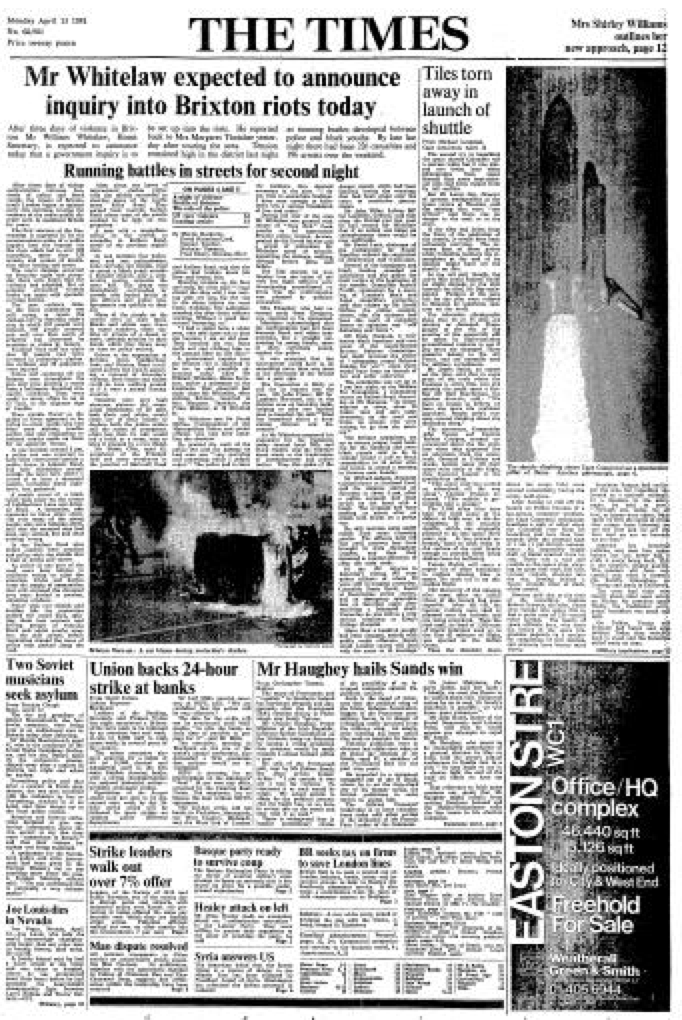
Between the events of Southall on 23 April 1979 and July 1981, there had been increasing riots in inner city areas across Britain, where black and white youth had reacted against the police and in some places, such as Southall, fascist agitation. Although there has been major emphasis in studies of the Thatcherite Government from 1979 to 1990 on Thatcher’s abhorrence of the trade unions and the focus of her Government on destroying an organised labour movement, the riots that occurred across Britain in 1981 have been largely overlooked. While the anti-union legislation and the Miners’ Strike are important elements of the dominance of Thatcher’s neo-liberalism during the 1980s that involved high levels of confrontation between the state and the labour movement, the first major confrontation between the repressive institutions of the state and the ‘subversive’ sections of British society was not with the trade unions, but with Britain’s black population, particularly black youth in the inner cities.
The first major riot was in Bristol on 2 April 1980, followed by a much larger outbreak in Brixton between 10-12 April, 1981 before culminating in riots across Britain in July 1981. These riots can be seen as the reaction to the lack of a political voice by Britain’s black communities and to the racism of the police directed primarily at black youth, as well as against the Conservative Government. The riots were symptomatic of the wider disillusionment, shared by both black and white youth, with the Conservative Government’s repressive police tactics and monetarist economic policies, which contributed to high unemployment. The problem of police racism, at the centre of these riots, was, as Stuart Hall wrote, ‘where blacks and others encounter a drift and a thrust towards making the whole of society more policed’.[1] By the early 1980s, the police strategy in the urban inner cities was making a strong and visible presence of police power under the auspices of maintaining ‘law and order’ and taking a strong stance against street crime. As the Communist Party declared in May 1980, ‘the hawks are in control in the Metropolitan police force’.[2]
The first major confrontation was on 2 April, 1980 in the St Paul’s District of Bristol, when approximately fifty policemen raided a café that was patronised primarily by Afro-Caribbeans, which caused a confrontation between 2,000 mainly black citizens and over 100 policemen.[3] The confrontation was significant because of its scale and intensity, including burning and looting of private property and the racial aspect of the incident.[4] The clash was, Dilip Hiro wrote, a reaction to the confrontational tactics of the police against the black community.[5] The CPGB saw that the events in Bristol ‘were no “spontaneous riot” because there was nothing spontaneous about racial oppression – or its response’.[6] What Bristol demonstrated, Neville Carey predicted in Comment, was that ‘we are heading towards open warfare in deprived areas containing large numbers of unemployed youth’ as the police were being increasingly used to deal with troubles caused by the combination of racism and unemployment.[7] A petition with these immediate demands was circulated by the CPGB following the riot, but Carey admitted that the Communist Party was ‘doing far too little’ in working with the black communities, who mistrusted the opportunism and arrogance of the white left.[8] Carey warned that it would ‘take a great deal of mass pressure from the Left and progressive movements to stop this Law and Order government from encouraging the use of even greater force to deal with social discontent’.[9] But Bristol was only ‘the shape of things to come’.[10] As Harris Joshua and Tina Wallace wrote, ‘the same basic pattern of violence was to be repeated in almost every major city with a black population, precipitating a crisis of race unprecedented in the post-war era, and a crisis of law and order unprecedented since the 1930s’.[11]
On 10 April, 1981, a riot broke out in Brixton after the police stopped an injured youth on the street and the crowd reacted to the heavy police presence. Two events preceded the Brixton riots that contributed to eruption of action against the police. In January 1981, a fire on New Cross Road in Deptford led to the deaths of thirteen black youth. The fire was believed to have been started by a white racist, but the police investigation failed to arrest anyone connected to the fire, further angering the black community.[12] This resulted in large protests by the black communities, with little involvement from the white left and progressive movements, which was different from the political mobilisations of the late 1970s around Grunwick and the Anti-Nazi League. The mobilisation of thousands after the New Cross Fire ‘indicated the extent to which they had been frustrated… from expressing themselves politically’.[13] This mobilisation was against the disinterest and ineptitude of the initial police investigation and the mainstream press until the black protest had ‘drawn attention to the deaths and the official silence by marching through central London’.[14] Paul Gilroy wrote, ‘The tragic deaths set in motion a sequence of events which lead directly to the explosion in Brixton in April 1981, and provided a means to galvanize blacks from all over the country into overt and organized political mobilisation’.[15]
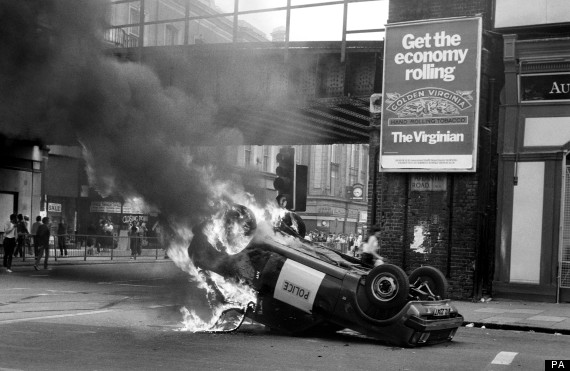
Another event that contributed to the Brixton riots was the strategy launched by the police in the week before the riot. Operation ‘Swamp 81’ was launched by the Lambeth police on 6 April, 1981. The purpose of ‘Swamp 81’ was to ‘flood identified areas on “L” District [Lambeth] to detect and arrest burglars and robbers’ with success, according to the police, depending on a ‘concentrated effort of “stops”, based on powers of surveillance and suspicion proceeded by persistent and astute questioning’.[16] In four days, the squads stopped 943 people and arrested 118, with only seventy-five charged, one with robbery.[17] The fact that so many police were deployed to street patrols in the immediate days preceding the riots contributed to the massive police response to the riots. Even after the first confrontations on 10 April, the operation continued with an extra ninety-six officers deployed to Brixton on 11 April. After the initial confrontation between police officers and a crowd of black youth on the evening of 10 April, 1981, rumours of police violence and several other incidents involving police and youths erupted into rioting across Brixton on 11 April and was finally quelled the following day. In the course of the events over that weekend, around 7,000 police officers were deployed to Brixton to restore order, although as John Benyon claimed, ‘during the worst night of violence on Saturday 11 April it seems that a few hundred people were involved’.[18] In the aftermath, 450 people, including many policemen, were injured, with 145 buildings and 207 vehicles damaged and the total damage bill amounting to £6.5 million.
After the Brixton riots, there was outrage from the Government, high-ranking police officials and the mainstream press, with Lord Scarman appointed to launch an inquiry into the events. But as Dilip Hiro wrote, ‘the root causes which led to the Brixton rioting persisted and Britain experienced a spate of violent disorders a few months later’.[19] Most major cities with black populations experienced rioting of some level, beginning on 3 July in Toxteth and Southall before spreading to Mosside and then to most other cities over the weekend of 10-12 July, 1981. ‘The incidents which ignited the disturbances varied enormously from place to place’ noted Chris Harman, with some incidents sparked by police harassment, others by racist attacks and fascist agitation or elsewhere, ‘the eruptions were “spontaneous” – youth on the streets just started looting and that was it’.[20] The official estimate of the total costs of damage caused during the July riots was £45 million, with £17 million caused to private property.[21] Around 4,000 people were arrested and ‘of the 3,704 for whom data was available, 766 were described as West Indian or African, 180 as Asian, 292 as “other” and 2,466 or 67% were white’, while around sixty six percent were under the age of twenty one and about half were unemployed.[22]
‘Crisis in the Inner Cities’: The Communist Party’s Reaction
The CPGB’s National Race Relations Committee (NRRC) had first begun preparing for a discussion conference, ‘Racism and the Police’ in October 1980, declaring that the ‘role of the police has become a central issue of anti-racist politics…loom[ing] large in any serious discussion of “institutionalised” racism and how to combat it’.[23] The NRRC invited representatives from black organisations, political parties, anti-racist, civil liberties and legal organisations, labour movement bodies and individuals to ‘assist the process of drawing up clear proposals for which the labour, democratic and anti-racist movements can campaign’.[24] The NRRC acknowledged that it would ‘not be a policy-making Conference’, but felt that the issue of police racism ‘urgently needs bringing down from the level of generalities to practical proposals’.[25] The conference was attended by around 160 delegates and put forward a ‘Charter of Demands’, published in Comment on 21 February, 1981 and then reproduced, along with the conference speeches, in a pamphlet Black and Blue, published in November 1981.[26]
The editors of the pamphlet, Dave Cook and Martin Rabstein, emphasised the wide range of groups involved in the conference, although many of the groups were represented by members of the Communist Party. Through this conference, the Communist Party believed it was ‘performing its key role of welding together…toward[s] the construction of the broad democratic alliance’.[27] The Party hoped that the ‘Charter of Demands’ was ‘one component part of a programme to democratise, to force democratic victories in the teeth of what will be the most powerful opposition in various parts of the apparatus of state’.[28]
Keeping with the framework of the broad democratic alliance, the ‘Charter’ called for consultation between the police and ‘genuine representatives of black communities’ as Britain’s black communities needed ‘community policing with democratic accountability and control, not saturation policing’.[29] ‘Hard’ policing, such as Operation ‘Swamp 81’, was seen as keeping the black communities under control, rather protecting it and the ‘Charter’, like the resolutions put forward at the CPGB’s National Congress, called for the removal of ‘SUS’ and the disbanding of the SPG.[30]
Included in the ‘Charter of Demands’ were proposals put forward by the Communist Party previously, calling for ‘race relations and public order law’ to be ‘firmly enforced against racists’ and ‘given more teeth to outlaw the advocacy and practice of racism’.[31] As with the Party’s stance on immigration control, the Race Relations Act and anti-fascism, the repressive and anti-left bias of the state was weighed against the practical use of the state to combat racism. The police, who were at the forefront of the fractuous relationship between the black communities and the state, were widely seen as incapable of mending community relations, but, in line with the ideals of the broad democratic alliance, the CPGB stated its commitment to the ‘rights of the “non-political” individual – the right to be free of harassment, the right to walk without fear on the streets’, which the Party believed needed to be protected by some kind of police force.[32]
After the riots in July, the CPGB’s Executive Committee released a statement, ‘Crisis in the Inner Cities’, describing the disturbances as a reaction to long-term problems that had developed in the urban inner-cities, ‘in the context of both the deep crisis affecting our economy, and the particular consequences of Thatcher’s policies’.[33] However the Party noted that it was ‘crude economic reductionism’ to simplify the argument to ‘economic crisis = disturbances on the streets’, recognising the ‘important racial dimension’ of the riots.[34] The riots were not an isolated issue of ‘law and order’, but partly a wider reaction to the repressive actions of the police and the monetarist economic policies under Thatcherism, with the CPGB leadership stating:
Thatcher is blind to the part played by her disastrous economic and social policies in causing the disturbances, and the police chiefs are blind to the connections between their everyday methods of policing and the violence they face.[35]
Therefore, the black and white youth were ‘not rioting against society at large, but were rioting against the police, against unemployment, against racism’.[36] The Party saw the broad democratic alliance put forward in The British Road to Socialism as the necessary strategy for the working class ‘to force democratic victories’ within ‘the most powerful opposition in various parts of the apparatus of state’,[37] which looked to working within the present system for immediate victories while attempting to build popular opposition for long-term reform. The response by the labour movement and the left had to be, the Party declared, more than simply ‘getting rid of the Tories’, instead it was to ‘respond to the immediate demands of the black community’, as the Party urged these organisations to campaign at local level, ‘linked to the need for left alternative policies nationally’.[38]
Lord Scarman’s Report and the Denial of Institutional Racism
Unlike the triumphalism of the state and strong Government celebrated by the Conservatives after the Falklands War and the Miner’s Strike, the aftermath of the 1981 riots saw the Government having to partially retreat from its forceful ‘law and order’ position and make concessions that police tactics in the black communities did involve racist and alienating behaviour. Although there was much speculation over the cause of the riots and numerous objections to their violence, many acknowledged that the heavy-handed police actions in the black communities over the previous decade had been a principal factor in provoking such a violent reaction by black youth.
Lord Scarman’s Inquiry was primarily focused on the events in Brixton, although the Government asked Scarman to take the July riots into account, but as Joe Sim noted, ‘This request was not evident in the final draft’.[39] The Scarman Report, wrote Stuart Hall, ‘was no panacea’, but ‘broke the prevailing law-and-order consensus’ that left the police blameless,[40] instead arguing that the ‘problem of policing a deprived, multi-racial area like Brixton cannot be considered without reference to the social environment in which the policing occurs’.[41] In reference to the environment of deprivation that existed in Britain’s inner cities, which increasingly suffered from the monetarist policies of the Conservative Government, the Scarman Report explicitly stated that there could be ‘no doubt that unemployment was a major factor… which lies at the root of the disorders in Brixton and elsewhere’.[42] Scarman acknowledged that the black community face similar problems to the wider working class in areas such as education, unemployment and discrimination, but on a much more severe scale. The result of this was that ‘young black people may feel a particular sense of frustration and deprivation’.[43] Scarman also found the riots to be ‘a spontaneous reaction to what was seen as police harassment’.[44]
However while Scarman criticised some of the actions by the police, the Report, on the whole, stood in favour of the police force. Scarman concluded that ‘the power to stop and search’, one of the immediate factors for racial harassment by the police, was ‘necessary to combat street crime’.[45] From this decision, Scarman found that ‘the direction and policies of the Metropolitan Police are not racist’, but did admit that ‘racial prejudice does manifest itself occasionally in the behaviour of a few officers on the streets’.[46] What the Brixton riots did reveal for Lord Scarman was ‘weakness in the capacity of the police to respond sufficiently firmly to violence in the streets’, finding that ‘the use of “hard” policing methods, including the deployment of the Special Patrol Group, is appropriate, even essential’.[47] Scarman concluded that ‘racial disadvantage and its nasty associate, racial discrimination’ still existed in British society, but controversially declared that ‘“Institutional racism” does not exist in Britain’.[48] This denial of institutional racism by Scarman demonstrated, according to Martin Barker and Anne Beefer, that Scarman’s Report was ‘a liberal Report, but one within entirely racist parameters’.[49]
The Scarman Report was criticised by the Communist Party’s National Race Relations Committee for its failure to recognise the existence of institutional racism, describing the Report as ‘full of contradictions’.[50] Some positive elements to the Report conceded by the Party were the connections between the disturbances and the economic crisis, racism within the police, community policing, the banning of racist marches and anti-racist training for the police, although many of these points included criticisms of their weaknesses.[51] Other parts of the Report were described as ‘just plain bad’, with the Party asserting that the Report contained ‘no explicit criticism of the Government’s economic and social policies’, the token gesture of a liaison committee with only ‘consultative’ powers, the negligent mention of racist attacks on black people and most importantly, the denial of institutional racism.[52]
At the CPGB’s National Congress in December 1981, the Party repeated the call for an accountable and co-operative police force, working with the black community, while calling for greater Party work within local communities, particularly in response to unemployment, the police and racism.[53] On the issue of racism, the Party recognised the ‘rightward shift in British politics affecting all aspects of life’ and expressed ‘great concern [at] the growing activities of racist and fascist organisations, and particularly the growing attacks on black people’.[54] The Anti-Nazi League had defeated the National Front electorally but fascists were ‘now returning to [the] traditional policy of street terrorism and underground activity’.[55] In the struggle against racism, the Party stated that it ‘must seek to win many more black members to its ranks’, but recognised that this was difficult and would ‘only happen inasmuch as the Party is consistently involved in fighting on the issues that the black community recognises as the most urgent’.[56] While the CPGB saw potential for the Party and the Young Communist League to help the youth, such as those involved in the riots, to ‘become involved… in non-anarchic, non-individualistic forms of mass action’, the Party failed to make headway in the black community and the Party’s membership continued to decline. Youth unemployment did not propel many youth towards the left, with the ‘overwhelming majority of the young unemployed remain[ing] apolitical’ and as Kenneth Roberts wrote, ‘Rather than being channelled into party politics, their discontents are more likely to be expressed on the streets’.[57] By the time of the 1985 riots in London and Birmingham, Thatcher had defeated the trade unions in the Miners’ Strike, had seen the British Army victorious in the Falklands War and had led a sustained campaign of privatisation of British industry – unlike the vulnerability experienced after the 1981 riots, Thatcherism was now at its hegemonic height.
———————————————-
[1] Stuart Hall, ‘Policing the Police’, in Dave Cook & Martin Rabstein (eds), Black & Blue: Racism and the Police, CPGB pamphlet, London, 1981, p. 7
[2] Jackie Heywood, ‘Police Hawks Come Out On Top’, Comment, 10 May, 1980, p. 151
[3] Dilip Hiro, Black British, White British: A History of Race Relations in Britain, Paladin, London, 1992, p. 85
[4] H. Joshua & T. Wallace, To Ride the Storm, p. 7
[5] D. Hiro, Black British, White British, p. 86
[6] Hackney CP Branch Internal Policy Document, n.d., CP/LON/BRA/09/11, LHASC
[7] Neville Carey, ‘Bristol Police Fail in Take Over Bid’, Comment, 26 April, 1980, p. 136
[8] N. Carey, ‘Bristol Police Fail in Take Over Bid’, p. 137
[9] N. Carey, ‘Bristol Police Fail in Take Over Bid’, p. 136
[10] Chris Harman, ‘The Summer of 1981: A Post-Riot Analysis’, International Socialism, 2/14, Autumn 1981, p. 1
[11] H. Joshua & T. Wallace, To Ride the Storm, p. 7
[12] D. Hiro, Black British, White British, p. 87
[13] Darcus Howe, ‘Brixton Before the Uprising’, Race Today, February/March 1982, p. 69
[14] P. Gilroy, There Ain’t No Black in the Union Jack, p. 130
[15] P. Gilroy, There Ain’t No Black in the Union Jack, p. 129
[16] Cited in, Lord Scarman, The Scarman Report: The Brixton Disorders 10-12 April 1981, Penguin Books, Harmondsworth, 1986, p. 95, Italics are my emphasis
[17] D. Hiro, Black British, White British, p. 87; P. Gilroy, There Ain’t No Black in the Union Jack, p. 132
[18] D. Hiro, Black British, White British, p. 88; John Benyon, ‘Going Through The Motions: The Political Agenda, the 1981 Riots and the Scarman Inquiry’, Parliamentary Affairs, 38/4, 1985, p. 409
[19] D. Hiro, Black British, White British, p. 88
[20] C. Harman, ‘The Summer of 1981’, p. 5
[21] D. Hiro, Black British, White British, p. 90
[22] J. Benyon, ‘Going Through The Motions’, p. 410
[23] Conference Invitation to ‘Racism and the Police’, October 1980, CP/LON/RACE/02/11, LHASC
[24] Conference Invitation
[25] Conference Invitation
[26] ‘Racism and the Police’, Comment, 21 February, 1981, pp. 6-7
[27] D. Cook & M. Rabstein, ‘Inner City Crisis’, in D. Cook & M. Rabstein, Black & Blue, p. 6
[28] Dave Cook, ‘Charter of Demands’, in D. Cook & M. Rabstein, Black & Blue, p. 32
[29] ‘Racism and the Police’, p. 6
[30] ‘Racism and the Police’, p. 7
[31] ‘Racism and the Police’, p. 7
[32] D. Cook & M. Rabstein, Black & Blue, p. 6
[33] ‘Crisis in the Inner Cities’, Executive Committee Statement, 12-13 September, 1981, p. 1, CP/CENT/CTTE/02/06, LHASC
[34] ‘Crisis in the Inner Cities’, p. 2
[35] ‘Crisis in the Inner Cities’, p. 6
[36] ‘Crisis in the Inner Cities’, p. 9; Italics are in the original text
[37] ‘Crisis in the Inner Cities’, p. 11
[38] ‘Crisis in the Inner Cities’, p. 10; p. 11
[39] Joe Sim, ‘Scarman: The Police Counter-Attack’, Socialist Register, 1982, p. 58
[40] Stuart Hall, ‘From Scarman to Stephen Lawrence’, History Workshop Journal, 48, Autumn 1999, p. 188
[41] L. Scarman, The Scarman Report, p. 194
[42] L. Scarman, The Scarman Report, p. 205
[43] L. Scarman, The Scarman Report, p. 194
[44] L. Scarman, The Scarman Report, p. 195
[45] L. Scarman, The Scarman Report, p. 207
[46] L. Scarman, The Scarman Report, p. 198; Italics are my emphasis
[47] L. Scarman, The Scarman Report, p. 201
[48] L. Scarman, The Scarman Report, p. 209
[49] Martin Barker & Anne Beezer, ‘The Language of Racism – An Examination of Lord Scarman’s Report and the Brixton Riots’, International Socialism, 2/18, p. 108
[50] ‘The Scarman Report’, December 1981, CP/CENT/CTTE/02/06, LHASC
[51] ‘The Scarman Report’
[52] ‘The Scarman Report’
[53] ‘Social and Economic Policy’, Comment, 5 December, 1981, p. 39
[54] ‘Racism’, Comment, 5 December, 1981, p. 37
[55] ‘Racism’, p. 37
[56] ‘Racism’, p. 38
[57] Kenneth Roberts, ‘Youth Unemployment and Urban Unrest’ in, J. Benyon, Scarman and After, p. 182
 New Historical Express
Leave a comment